By Danielle Lancaster
The days are flying far too quickly, yet I am finding myself now taking a much different approach to my photography. The reason is simple; I am seeing a more in-depth side through friends such as Chanman and his family, the nuns, Somnieng, second head monk of Wat Damnak, my photography buddies and more.
When I first arrived I was shooting predominantly high key work, much I presume was due to my mood on arrival and now that has changed in the last day and my work has taken on a darker tone.
In the last day I have seen a traditional medicine man wave a ‘hand’ of healing, monks dying while in the care of young boy monks, and listened.
Life in a nunnery is rather unique, I am quickly finding bonds with the Don Chee’s and others that live within the confines’ of the monastery, near the heart of ancient Siem Reap and its temples.
We all see things differently. As I compile my photo essay and sift and edit through the countless images two things are coming glaring out at me: to crop or not and busy backgrounds.
This is one image I have tagged for the final cull in my photo essay. My question is: Should I crop or not?
All cropping will be done using the aspect ratio of 35mm as that is what I am shooting and how I believe it should be done.
My whole photo essay is being shot using natural light. This at times is challenging as the light can be very poor and when working in nano seconds there is much to take into account quickly for correct composition and exposure. There is a law in psychology, the law of partial fulfilment, and I experience it here. Sometimes I get what I want, sometimes I don’t and I keep going back.
Items pleasing to the mind such as juxtaposition, repetition of pattern and element to make an image graphic and rewarding to the viewer are forever here pushing me and pushing me.
While I think the work will work fine in colour, I have decided to make it black and white due to my subject matter. The number of images in the final body I am yet unsure of and no doubt will have a little panic attack before it is submitted tomorrow.
So I prepare for another day out shooting and dare I say, I am already planning my return journey back.
Monday, 28 June 2010
Saturday, 26 June 2010
Always Pushing Yourself Photographically
By Danielle Lancaster
Another day in Cambodia has passed and let we say it has been an interesting one.
Filled with photographic, spiritual and emotional challenges, here’s a glimpse:
A day with the nuns was challenging yet so very, very rewarding, mixed with a well deserved dunking and drying of sweat in the pool between downloads, lunch, 1 million litres of water (maybe a little exaggeration on the last one but it has been hot), then out again for the welcoming ceremony for Somnieng, at the temple of Wat Damnak (as mentioned in last Blog).
This three hour plus event sees all the ‘white nuns’ lined up in order of their level. Somnieng sees me a while after my arrival, and points and waves. A sea of shaved heads turns towards me. By now, second ‘grade white nuns’ have encouraged and welcomed my ‘move’ into their lines and soon after I am with the Don Chees, the highest of the nuns and for many the saviour of Cambodian Buddhism.
Danielle shooting portraits against a hand painted ceiling.Image by: Kelly McIlvenny's
Jack and Will showed us a series dynamic photojournalistic slide shows and presentations of both their own work and that of students they have mentored/taught. It makes me now realise how far behind in this media I have become and that has to change, however I did record sound on the old D3 today of the chanting so am making a concerted effort.
Image by Danielle Lancaster
We receive great critique of our works in progress and Tim over dinner critiques another full card of mine and on the image above says: ‘Would have liked to see the third head to continue the curves’. Please note this is not word for word. Composition, we discuss, remains an important part of our image making and images require lead in’s to bring the viewer in and hold them. Can you believe it was due to a big whooping cement pylon not allowing me to get back, however as Jack says I could have got down even 3 inches, moved just a fraction and done more. I agree and even though shooting, when I can, frames from different perspectives this is all about pushing ourselves to another level in our photography.
Another day in Cambodia has passed and let we say it has been an interesting one.
Filled with photographic, spiritual and emotional challenges, here’s a glimpse:
A day with the nuns was challenging yet so very, very rewarding, mixed with a well deserved dunking and drying of sweat in the pool between downloads, lunch, 1 million litres of water (maybe a little exaggeration on the last one but it has been hot), then out again for the welcoming ceremony for Somnieng, at the temple of Wat Damnak (as mentioned in last Blog).
This three hour plus event sees all the ‘white nuns’ lined up in order of their level. Somnieng sees me a while after my arrival, and points and waves. A sea of shaved heads turns towards me. By now, second ‘grade white nuns’ have encouraged and welcomed my ‘move’ into their lines and soon after I am with the Don Chees, the highest of the nuns and for many the saviour of Cambodian Buddhism.

Jack and Will showed us a series dynamic photojournalistic slide shows and presentations of both their own work and that of students they have mentored/taught. It makes me now realise how far behind in this media I have become and that has to change, however I did record sound on the old D3 today of the chanting so am making a concerted effort.
Image by Danielle Lancaster
We receive great critique of our works in progress and Tim over dinner critiques another full card of mine and on the image above says: ‘Would have liked to see the third head to continue the curves’. Please note this is not word for word. Composition, we discuss, remains an important part of our image making and images require lead in’s to bring the viewer in and hold them. Can you believe it was due to a big whooping cement pylon not allowing me to get back, however as Jack says I could have got down even 3 inches, moved just a fraction and done more. I agree and even though shooting, when I can, frames from different perspectives this is all about pushing ourselves to another level in our photography.
Tim Page with Danielle at dinner.
Tim first visited Cambodia in 1964 and has seen many, many changes.
Thursday, 24 June 2010
A State of Flux
My assignment here in Siem Reap is ‘Flux’. What is flux? As per a dictionary definition: Flux/fluks/ noun The act of flowing; a continuous moving on or passing by as, as of a flowing stream; constant succession; change. Synonyms: Change, Instability, Fluctuation, Unrest, Variance.
I believe there are many ways to interrupt this and upon being given it last night I have varied my line of thought along many tracks: medicine from the traditional medicine man of Asia to western medicine, Buddhism, economy, rubbish, love, rebirth, even tourism. However, two things are coming to the forefront in my mind: Trust and the role of women have played in Cambodian Buddhism since the country was relieved of the cruel regime created by Pol Pot.
For those of you who may not know, Pol Pot was responsible for the deaths of over two million of his own people during his ferocious regime in which he renamed Cambodia Kampuchea (that’s more than 25% of the country’s population). A whole generation was almost wiped out. All of Cambodia's cities were then forcibly evacuated. At Phnom Penh, two million inhabitants were evacuated on foot into the countryside at gunpoint. As many as 20,000 died along the way.
This resulted in the country being thrown into turmoil. At the start of Pol Pot’s regime there were more than 2000 doctors at the finish there were 4. People starved in fields and he started the infamous S-21 interrogation centre where more than 20,000 men, women and children were tortured to death. It is a part of history we should all know about, as things such as this are still happening across our globe.
Enough on history for today and back to my assignment as the heat outside starts to soar. Unfortunately, not like some of my photography comrades here I am not armed with a Leica – worse luck - and will make do with what I have got on hand. My trusty D3 I hope will deliver. Is it not the person behind the camera and how they interrupt their scene and not always the machine itself? I will though admit with such calibre of photography prowess around me I do feel a little daunted and yes out of my depth to capture images as dramatic and storytelling as they have done in the past. But I will tell a story.
So where am I starting. Well straight upfront by wondering into a temple and asking with a very big smile to meet the head monk. I am delighted as Somnieng, the Executive Director and founder of Life and Hope and second head monk of the temple of Wat Damnak welcomes me. We sit in the shade and our conversation spans more than an hour.
We quickly form a bond. We talk on trust and how Cambodians during the Pol Pot regime lost trust in each other. He explains his philosophy behind Life and Hope. It is simple yet resounding. Life + Hope = Change. Life +Hope + Education = Greater Change. He agrees to ask the white nuns if I may come and live with them for a few days and observe their way of life and asks me to join him this afternoon in delivering rice to outlying rural communities and to be present for his welcoming ceremony tomorrow, visit his orphanage and anything else I would like. The school children resting under the trees outside have now left, back to the class rooms and I offer to prepare a presentation on Australia which he readily accepts.
So what will moving into the temple with the white nuns mean? It will mean observing the life of a white nun and abiding by their daily rituals of meditation, cleaning and devotion. This in a month or so will be something everyone can do coming to Siem Reap as Somnieng prepares for the launch of his Angkor Retreat Program (his first two 7 days retreats are already booked out). “We want our friends to come and learn and have a real experience, learn our culture, hear the history of the temples with us, real monks, as their guides and practice the compassion of life. This will generate our good heart and help us heal and learn to trust and it will allow those who come and stay to go back home and carry a mindful life.’
He is a man devote on bringing happiness and smiles back to his people I am so very privileged to be allowed to experience this first hand. I am not expecting to capture award winning images. I am expecting though to have an experience and share that with others.
So now it is time for me to get ready as I am sure this will be a wonderful adventure for not only me and my camera but my soul as well. And of course a couple of images from today and with time not on my side, unprocessed but at least backed up!
I believe there are many ways to interrupt this and upon being given it last night I have varied my line of thought along many tracks: medicine from the traditional medicine man of Asia to western medicine, Buddhism, economy, rubbish, love, rebirth, even tourism. However, two things are coming to the forefront in my mind: Trust and the role of women have played in Cambodian Buddhism since the country was relieved of the cruel regime created by Pol Pot.
For those of you who may not know, Pol Pot was responsible for the deaths of over two million of his own people during his ferocious regime in which he renamed Cambodia Kampuchea (that’s more than 25% of the country’s population). A whole generation was almost wiped out. All of Cambodia's cities were then forcibly evacuated. At Phnom Penh, two million inhabitants were evacuated on foot into the countryside at gunpoint. As many as 20,000 died along the way.
This resulted in the country being thrown into turmoil. At the start of Pol Pot’s regime there were more than 2000 doctors at the finish there were 4. People starved in fields and he started the infamous S-21 interrogation centre where more than 20,000 men, women and children were tortured to death. It is a part of history we should all know about, as things such as this are still happening across our globe.
Enough on history for today and back to my assignment as the heat outside starts to soar. Unfortunately, not like some of my photography comrades here I am not armed with a Leica – worse luck - and will make do with what I have got on hand. My trusty D3 I hope will deliver. Is it not the person behind the camera and how they interrupt their scene and not always the machine itself? I will though admit with such calibre of photography prowess around me I do feel a little daunted and yes out of my depth to capture images as dramatic and storytelling as they have done in the past. But I will tell a story.
So where am I starting. Well straight upfront by wondering into a temple and asking with a very big smile to meet the head monk. I am delighted as Somnieng, the Executive Director and founder of Life and Hope and second head monk of the temple of Wat Damnak welcomes me. We sit in the shade and our conversation spans more than an hour.
We quickly form a bond. We talk on trust and how Cambodians during the Pol Pot regime lost trust in each other. He explains his philosophy behind Life and Hope. It is simple yet resounding. Life + Hope = Change. Life +Hope + Education = Greater Change. He agrees to ask the white nuns if I may come and live with them for a few days and observe their way of life and asks me to join him this afternoon in delivering rice to outlying rural communities and to be present for his welcoming ceremony tomorrow, visit his orphanage and anything else I would like. The school children resting under the trees outside have now left, back to the class rooms and I offer to prepare a presentation on Australia which he readily accepts.
So what will moving into the temple with the white nuns mean? It will mean observing the life of a white nun and abiding by their daily rituals of meditation, cleaning and devotion. This in a month or so will be something everyone can do coming to Siem Reap as Somnieng prepares for the launch of his Angkor Retreat Program (his first two 7 days retreats are already booked out). “We want our friends to come and learn and have a real experience, learn our culture, hear the history of the temples with us, real monks, as their guides and practice the compassion of life. This will generate our good heart and help us heal and learn to trust and it will allow those who come and stay to go back home and carry a mindful life.’
He is a man devote on bringing happiness and smiles back to his people I am so very privileged to be allowed to experience this first hand. I am not expecting to capture award winning images. I am expecting though to have an experience and share that with others.
So now it is time for me to get ready as I am sure this will be a wonderful adventure for not only me and my camera but my soul as well. And of course a couple of images from today and with time not on my side, unprocessed but at least backed up!
A White Nun, Donchee, makes an offering.
This lady lost her husband during the Pol Pot Regime.
Image by Danielle Lancaster
At the temple of Wat Damnak a monk writes a message.
Image by Danielle Lancaster.
I sit with a group of drivers on the gutter by the edge of the street.
We cannot speak each others language yet form a bond.
I observe their trust in each other and feel an honour to be allowed to sit and 'chat' and snap away.
Image by Danielle Lancaster
We cannot speak each others language yet form a bond.
I observe their trust in each other and feel an honour to be allowed to sit and 'chat' and snap away.
Image by Danielle Lancaster
Back in Siem Reap
By Danielle Lancaster
Touched down in Siem Reap at midday today – it’s so good to be back. On the way in, we flew over Tonle Sap – the largest lake in south-east Asia where Miss J and I myself visited last year. It fills with the waters of the Mekong and upon its waters sits whole villages. Their houses, multi storey wooden frames where families of 17 or more may reside in one room with the pigs, hens and any other animals supported upon frames under the main house but safe from the water below. If you are ever over this way, mark it as a must do.
After I checked in to my room I did what any person would do lugging a heavy pack loaded with camera gear would do and headed for my favourite massage haunt downtown. After an hour and a half of deep Khumer rubbing, pulling, cracking and a touch of reflexology, I feel fantastic and all for the total sum of $10 US.
Then I cruised through the old markets – in some places holding my nose on my way - to find an old friend and Miss J, if you are reading this, I found Chamnan and there were many hugs all round. He has loved his gifts and is in awe of how big Australia is. Chumnan was our driver last year with his Tuk Tuk and we formed a great bond with a highlight of our trip he taking to meet his wonderful family over an hour away from Siem Reap who he sees only every few months. It broke our hearts as we were leaving seeing his twin girls and wife with new baby in arms crying.
The clouds have eventually broken and outside my room the rain is bucketing down giving some relief to the heat – a minor 31 degrees here today but plenty humid enough to have us all sweating well and truly.
Off to meet the others now (after a much needed shower) and receive our first assignment for tomorrow. Looking forward to getting to know one of my favourite places in Asia that bit better, shooting with the others and of course enjoying the fine cuisine of Khumer cooking!
Touched down in Siem Reap at midday today – it’s so good to be back. On the way in, we flew over Tonle Sap – the largest lake in south-east Asia where Miss J and I myself visited last year. It fills with the waters of the Mekong and upon its waters sits whole villages. Their houses, multi storey wooden frames where families of 17 or more may reside in one room with the pigs, hens and any other animals supported upon frames under the main house but safe from the water below. If you are ever over this way, mark it as a must do.
After I checked in to my room I did what any person would do lugging a heavy pack loaded with camera gear would do and headed for my favourite massage haunt downtown. After an hour and a half of deep Khumer rubbing, pulling, cracking and a touch of reflexology, I feel fantastic and all for the total sum of $10 US.
Then I cruised through the old markets – in some places holding my nose on my way - to find an old friend and Miss J, if you are reading this, I found Chamnan and there were many hugs all round. He has loved his gifts and is in awe of how big Australia is. Chumnan was our driver last year with his Tuk Tuk and we formed a great bond with a highlight of our trip he taking to meet his wonderful family over an hour away from Siem Reap who he sees only every few months. It broke our hearts as we were leaving seeing his twin girls and wife with new baby in arms crying.
The clouds have eventually broken and outside my room the rain is bucketing down giving some relief to the heat – a minor 31 degrees here today but plenty humid enough to have us all sweating well and truly.
Off to meet the others now (after a much needed shower) and receive our first assignment for tomorrow. Looking forward to getting to know one of my favourite places in Asia that bit better, shooting with the others and of course enjoying the fine cuisine of Khumer cooking!
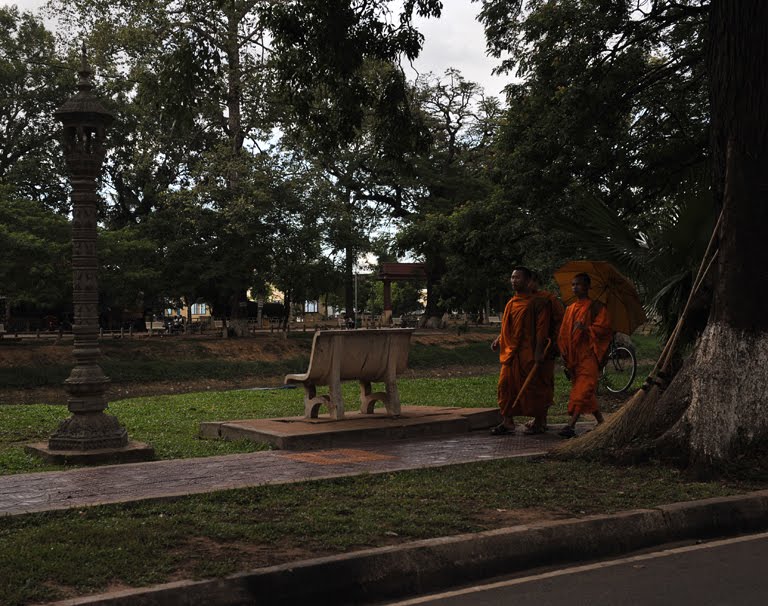
A walk in the park.
Imgae by Danielle Lancaster
A fabulous Cambodia friend - Chamnan
Wednesday, 23 June 2010
A Stop Over in Kuala Lumpur
By Danielle Lancaster
Well here I am in Kuala Lumpur (more commonly simply referred to as KL) on route to Siem Reap in Cambodia.
KL, with a population of well over 1.6 million people drawn from all of Malaysia’s ethnic groups, is the largest city in Malaysia. It is situated midway along the west coast of Peninsular Malaysia, at the confluence of the Klang and Gombek rivers. It is approximately 35 km from the coast and sits at the centre of the Peninsula's extensive and modern transportation network.
As I exited the plane after a lengthy 10 hour flight, which did allow me to catch up on some well earned sleep, the first thing you can’t help noticing is the heat – it literally has you holding your breath as it hits you. Today KL welcomed me with a humid 32 degrees, rather different from the winter cool of southern Queensland where I have been stoking a fire every night since winter arrived.
I am staying at My Hotel @ Sentral, conveniently located to the bus and rail system. The bus ride from the airport, while an hour in length cost me a total of 8 Malaysia Ringgits which is the equivalent of $2.84 AUD. I was the only white woman on the bus, surrounded mainly by Indians here for a conference. It quickly had a few with their cameras out to snap the white girl in a sea of dark faces until the ‘friendly’ Malaysian authorities were tapping and shouting for cameras down and bums in seats. I immediately decided to leave my camera in its bag and enjoy the scenery.
KL is a city that has grown rapidly. On a walk around the few blocks from my hotel this evening, this was clearly evident. Within half a block obvious well off Malaysians and tourists dine and drink on beautifully prepared meals and fine beverages while down an alley no more than a few metres away homeless try to make themselves comfortable for the evening on cement walkways. The other evident thing, and you smell it before you see it, is the rotting stench of rubbish. With the growth, so has grown the rubbish piles and though not a problem related to just this nation’s capital, it is the odour that has my mind whirling to other regions facing the same fast-paced problem of ‘what to do with our rubbish?’
I decide to dine for the evening in a clean looking restaurant next door to my hotel and order Asam Laksa (a noodle based soup), iced coffee and a bottle of water. Total cost $6.00 AUD. It is filling, refreshing and puts fuel in my tummy and while sipping my soup a breeze starts to blow reducing the stifling heat and drying the sweat on myself and those dining around me.
Highlights for today include hitting the street and meeting the locals. I can’t speak a word of their language but they allow me to photograph them: tossing frying delicacies, repairing shoes and all sorts of other street activity. A young boy working a street stall with his parents and exercising his vocal cords drawing in the peak hour commuters to buy food from as he says the best family run stall in KL has me intrigued. He is happy to pose briefly and I show him an image I have taken of him. He screams with delight and lunges at my camera now wanting to take it home to show all his friends and family.
Another walk later tonight proves this is another city that night does not mean sleep. The cafes and restaurants at 11pm (I am 2 hours behind my fellow Australians) are still well patronised, buses and traffic are filling the roads, banks are open and cranes are still working building another concrete monster to fill the city skyline.
Here’s a couple of images from this walk – all unprocessed jpegs and hopefully I may have internet access for my second part in Siem Reap – one of my favourite ancient sites on Earth.
Well here I am in Kuala Lumpur (more commonly simply referred to as KL) on route to Siem Reap in Cambodia.
KL, with a population of well over 1.6 million people drawn from all of Malaysia’s ethnic groups, is the largest city in Malaysia. It is situated midway along the west coast of Peninsular Malaysia, at the confluence of the Klang and Gombek rivers. It is approximately 35 km from the coast and sits at the centre of the Peninsula's extensive and modern transportation network.
As I exited the plane after a lengthy 10 hour flight, which did allow me to catch up on some well earned sleep, the first thing you can’t help noticing is the heat – it literally has you holding your breath as it hits you. Today KL welcomed me with a humid 32 degrees, rather different from the winter cool of southern Queensland where I have been stoking a fire every night since winter arrived.
I am staying at My Hotel @ Sentral, conveniently located to the bus and rail system. The bus ride from the airport, while an hour in length cost me a total of 8 Malaysia Ringgits which is the equivalent of $2.84 AUD. I was the only white woman on the bus, surrounded mainly by Indians here for a conference. It quickly had a few with their cameras out to snap the white girl in a sea of dark faces until the ‘friendly’ Malaysian authorities were tapping and shouting for cameras down and bums in seats. I immediately decided to leave my camera in its bag and enjoy the scenery.
KL is a city that has grown rapidly. On a walk around the few blocks from my hotel this evening, this was clearly evident. Within half a block obvious well off Malaysians and tourists dine and drink on beautifully prepared meals and fine beverages while down an alley no more than a few metres away homeless try to make themselves comfortable for the evening on cement walkways. The other evident thing, and you smell it before you see it, is the rotting stench of rubbish. With the growth, so has grown the rubbish piles and though not a problem related to just this nation’s capital, it is the odour that has my mind whirling to other regions facing the same fast-paced problem of ‘what to do with our rubbish?’
I decide to dine for the evening in a clean looking restaurant next door to my hotel and order Asam Laksa (a noodle based soup), iced coffee and a bottle of water. Total cost $6.00 AUD. It is filling, refreshing and puts fuel in my tummy and while sipping my soup a breeze starts to blow reducing the stifling heat and drying the sweat on myself and those dining around me.
Highlights for today include hitting the street and meeting the locals. I can’t speak a word of their language but they allow me to photograph them: tossing frying delicacies, repairing shoes and all sorts of other street activity. A young boy working a street stall with his parents and exercising his vocal cords drawing in the peak hour commuters to buy food from as he says the best family run stall in KL has me intrigued. He is happy to pose briefly and I show him an image I have taken of him. He screams with delight and lunges at my camera now wanting to take it home to show all his friends and family.
Another walk later tonight proves this is another city that night does not mean sleep. The cafes and restaurants at 11pm (I am 2 hours behind my fellow Australians) are still well patronised, buses and traffic are filling the roads, banks are open and cranes are still working building another concrete monster to fill the city skyline.
Here’s a couple of images from this walk – all unprocessed jpegs and hopefully I may have internet access for my second part in Siem Reap – one of my favourite ancient sites on Earth.
Image by Danielle Lancaster
Sunday, 20 June 2010
How to Take Photographs Through Glass and Perspex
By Danielle Lancaster
Photography through glass and Perspex can be tricky. There is a myriad of situations where we could be faced trying to grab that image through glass or Perspex: a car, plane or coach window, through plate glass at a zoo or aquarium, along a street, through a display case and the list goes on.
Glass and Perspex reflect light and reflections are a bane to photographers. Why? Because what our brain tells us we see we don’t really see. We need to develop a photographer’s eye as the camera does not lie. We need to tune those reflections back in to our brain and really see them before we can deal with them.
Another problem often faced when photographing through these substrates is some cameras have difficulty focusing on the subject; instead the camera tries to focus on the reflection.
We also often see loss in image sharpness due to uneven glass and the images may look ‘muddy’ simply because the windows were dirty. Its one reason when I go up in a helicopter or plane my first question is ‘can I have the doors off or open?’
So here’s a few quick tips to help you face the challenges of photographing through glass:
When the sun is behind you, reflections are at a minimum.
Shoot at an oblique 45 degree angle to the glass.
Use a circular polarising filter. Remember they can accentuate the stress marks in the Perspex and spots on the glass.
Don’t use flash. If you have to, diffuse it, if possible bounce it and move the flash head to an angle so the reflected light from the flash bounces off the glass at an angle. You don’t want it coming straight back into the camera lens. A fast lens will often eliminate the need for flash.
Hold the camera as close to the glass as possible without touching it. A rubber lens hood is perfect for cutting out unwanted light.
When shooting through glass from within a moving object like a helicopter or coach use a fast shutter speed. Try pre focusing or continuous focusing. Use a mid range aperture to lengthen your depth of field which may assist with any focusing difficulties.
If hand holding and your lens has vibration reduction (VR), or image stabilisation (IR), use it!
It’s better, especially when doing photography from within a moving vehicle to wear dark clothing to minimise your own reflection.
Image taken at Australia Zoo by Anita Bromley
One of our favourite places is Underwater World on the Sunshine Coast in Queensland.
Image supplied by Underwater World.
Another from Underwater World
Image by Danielle Lancaster
Wednesday, 16 June 2010
As the Dust Settles on PSQ 2010
The dust has now settled on PSQ 2010 and no doubt the organisers should be having some well earned down time but as many of us know doing something for love means generally its back to the real world all too quickly and that well earned down time becomes a thing in our dreams.
PSQ 2010, hosted by the Brisbane Camera Group (BCG), has to be declared a roaring success. For those that attended there were exceptional speakers, workshops to get your creative juices flowing and the shutter button clicking, a range or professional advice readily given and some hot bargains from suppliers all in time for the end of financial year.
For me it was a time to catch up on with friends and industry acquaintances, see some fabulous images from camera groups members around Queensland, feel the excitement 12 years on after digital first came available to the masses (I do remember speaking at clubs 11 years ago where people told me it would not last), have a glimpse of where photography is leading us into the future such as the new NIK software –awesome stuff – and do a little photography shopping (a girl has to do what a girl has to do).
For those that missed it, maybe thinking PSQ was for camera club nerds only, think again. PSQ stands for the Photography Society of Queensland and each year they have their Photography Convention hosted by a club in Queensland – this is no mean feat. From my information from the organisers this conference averaged 180 people per day through the door plus organisers, sponsors, exhibitors, guest speakers and presenters. Take in a few logistics: international speakers and photographers, awards from entries pre conference to during conference, a convention dinner, auction (where thankfully the auctioneer could count after the odd rum or two), delegates from around Queensland, exhibitors and their stands, registrations, sales and the list becomes exhausting.
Next year it will be held by the Goondiwindi Photography Group and I must admit this pulls a special string with me, as Goondiwindi is what I call my ‘home’ town. Now for those of you who do not know, Goondiwindi is not a suburb of Brisbane (or even Sydney) so put down the UBD. It is about 3.5 hours west of Brisbane, yes that does mean a drive, but I can guarantee you these people know how to put on a show. The experience will be well and truly worth it and we, as a team here at Bluedog are looking forward to attending and supporting the Gundy Crew.
Below are a few images from the Goondiwindi Photography Club Members.
Here is a link to their website which will be having more added as the members prepare for the big ‘do’. http://psqgoeswest2011.weebly.com/index.html We’ll also be keeping people informed through the Bluedog Photography web site and our newsletter updates as speakers are confirmed.
We must make a special mention to Sue Black. Sue took out a huge amount of prizes for her club (Gold Coast). Since first attending a Bluedog Beginner Photography Workshop in October 2007 Sue has continued to grow her photography taking out many prizes. Well done Sue – it is so good to see someone living their dream!
Subscribe to:
Comments (Atom)