Showing posts with label Siem Reap. Show all posts

Thursday, 1 July 2010

Travel and Photography Tips for Travelling in Cambodia

Words and Images by Danielle Lancaster

As I make the journey back to Australia after a fabulous week in Siem Reap, Cambodia I thought I’d answer a few of the emails from people asking for tips to travelling to Cambodia in this blog.

There are loads of web sites with relevant information on travelling in Cambodia and it is a great idea to go through them but here’s a few of mine.

Allow more than one day to see the temples and buy a non consecutive day pass. There is more than Angkor Wat to see! The temples are huge and there can be a lot of walking. Allow time to see the outer temples such as Banteay Prey and Beng Melea. These are not included in your temple pass and are well worth seeing as they are less visited by tourists and amazing!

Never touch a monk! If handing a monk something always bow your head and hold the edge of the object closest to you and away from them. Always ask permission to photograph monks and white-robed nuns (Don Chees) before doing so – during Pol Pot around 95% of the monks in Cambodia disappeared in his eight point plan. They are special people and deserve respect. If they say no, put your camera down.

Make sure you have permission to photograph within any temple and/or pagoda
and treat the nuns and monks with respect.

When entering a temple take off your shoes, hat and sunglasses. Wear appropriate clothing to all non living and living temples. Shorts and singlet tops should be avoided. Look at Cambodian men – you will rarely see any men wearing shorts.

Drink plenty of water and watch the colour of your urine. Never drink any water from taps and always only drink bottled water. Most hotels and guest houses will supply two bottles of water each day and bottled water is easily bought. Use bottle water for brushing of teeth.

Lock your goods in your suitcase in your room and use a safety deposit box within your hotel/guest house for your passport.

Don’t buy from the street children. I know this can be hard as this is a very poor country, however if people keep buying from the children on the streets, around the temples etc and they continue to make any form of income from it their parents will keep them on the streets and not send them to school. School in Cambodia in our eyes is not expensive but in a country where they are lucky to earn $0.50 cents per day, education is the only way these beautiful people can move forward.

Cash is best. Make it US dollars and plenty of small notes – it’s also best to have loads of $1 notes. Not many places have credit card facilities and Cambodian money is often forfeited and not regularly dealt in. Don’t even bother with travellers cheques. When changing money ensure no notes have a tear in them as they will not be accepted and you will have to go to a bank to exchange.

Take plenty of $1 Us notes and make sure not one of your notes
has a tear in it no matter how small.

Be mindful of tourism traps like the Lake tour of Tonle Sap. There is more than one village on the lake and many operators take tourists to the ‘tourist’ one where you are taken to a floating souvenir shop and hassled by begging children and adults. There are other villages more worthy of visiting such as Kampong Phluk and while this is a bit of a drive by tuk tuk then dirt bikes (supplied at a meeting point with driver if needed) it is worth it.


On a photography note:
Make sure your lenses have a UV filter and rarely use your lens cap due to condensation build up. I actually take mine of before getting out of the plane and it does not go back on again till I have boarded on my way home.

Keep a cloth for cleaning your lens handy all the time. Cambodia can be very dusty.

Don’t count out visiting during the wet. Yes it is hot and humid but there are fewer tourists; the clouds make for wonderful images of the temples and landscapes and downpours are tropical so heavy and usually only short in duration, however it can make for some areas to be more difficult to get to. I have had some awesome experiences on dirt bikes during these times.

Find a good driver. I use Chamnan and am happy to pass on his details. He speaks very good English and knows the type of things photographers like to do. He is also willing to start early and finish late; however I also respect him and look after him. That is: I buy him water, food and little treats like spiders and crickets. I also pay him generously but each time I return he is the first to meet me with a huge smile and Cambodian bow greeting.

Learn the correct greeting: a bow and holding of the hands pressed together called a Sompeah. The lower the bow and the higher the hands, the more respect is shown. Handshakes are today used in business, however I still avoid this on all levels as a showing of respect. In Australia we tend to prefer firm handshakes – not in Cambodia as this can be interpreted as aggression. When exchanging business cards, the right hand or both hands should be used.

Cambodians do not hug and don’t like touching so be wary of this.

Learn to say thank you properly, again using the Sompeah gesture. And always smile. You will be rewarded with a wonderful experience.

Don’t go in with a fear factor. I have travelled in Cambodia as a lone female and yes a few years ago there were lots of jackings and bag snatching but this has become less and less. I travel at night on dirt bikes with drivers I do not know and never once felt threatened, actually the opposite they look after me and love that I will give it a go including riding through flooded streets with water up to our knees. On saying this though when I do go out at night I wear jeans and a t-shirt that covers my chest well and upper arms.

Don’t take the first price especially in the markets.

There are still land mines! Be careful where you go if you decide to walk off any well travelled track! It is thought there are still four and six million land mines not discovered and children and adults are still the victims even today of walking on a mine. Heavily mined areas include: Battambang, Banteay Meanchey, Pursat and Kampong Thom provinces however they are everywhere even around Angkor Wat and so it’s best to stay on well-travelled paths and have a knowledgeable guide or driver.

I spend time meeting people and going to their homes etc to photograph them. I always take a gift and wrap it but never in white as this is the colour of mourning. Present the gift to the oldest person in the house and use both hands with a bow. They will never open them on receipt so don’t be offended. Remove your shoes, hat and sunglasses before entering the home and never sit directly on the ground – even on a shoe is better than the ground.

Refreshments are often offered and should always be accepted even if only a little is taken. If you are offered to sit on a mat on the floor tuck your legs and feet backwards and never sit cross legged or stretch your legs out in front.

A lunch date with a medicine man in a village required proper etiquette.

Never photograph in airports, around military installations and railway stations – this is forbidden! Jail in Cambodia is not nice and often a short stay can quickly become a long stay.

Discretion should be used when photographing all Cambodian people, especially monks, members of the police and army.


Some ceremonies are very private. Again permission is required.


Please note: I was not in a temple or pagado while taking this image.
Image by: Kelly McIlvenny's

Never enter a school, orphanage or any place children are without the appropriate invitation and permission. There are strict laws concerning contact with Cambodian children and imprisonment can and does happen for immoral behaviour.

Trafficking of children for prostitution is growing especially young girls and some orphanages and homes are not run by ‘respectable’ people. It is estimated that there are approximately 80,000–100,000 prostitutes in Cambodia and that 30% of these are under 18 years of age – this is growing. Be careful and mindful especially when photographing children and if seen touching them in any manner. Again, jail here is not nice!
Before I photographed at this school,
I gained the appropriate permission and was esorted by a teacher.

Please don’t be deterred. Cambodia is a country that is oozing with photography opportunities. Enjoy this amazing country with its ancient temples and warm and friendly people, it’s why I go back each year!

Monday, 28 June 2010

To Crop or Not?

By Danielle Lancaster

The days are flying far too quickly, yet I am finding myself now taking a much different approach to my photography. The reason is simple; I am seeing a more in-depth side through friends such as Chanman and his family, the nuns, Somnieng, second head monk of Wat Damnak, my photography buddies and more.

When I first arrived I was shooting predominantly high key work, much I presume was due to my mood on arrival and now that has changed in the last day and my work has taken on a darker tone.

In the last day I have seen a traditional medicine man wave a ‘hand’ of healing, monks dying while in the care of young boy monks, and listened.

Life in a nunnery is rather unique, I am quickly finding bonds with the Don Chee’s and others that live within the confines’ of the monastery, near the heart of ancient Siem Reap and its temples.

We all see things differently. As I compile my photo essay and sift and edit through the countless images two things are coming glaring out at me: to crop or not and busy backgrounds.

This is one image I have tagged for the final cull in my photo essay. My question is: Should I crop or not?


All cropping will be done using the aspect ratio of 35mm as that is what I am shooting and how I believe it should be done.

My whole photo essay is being shot using natural light. This at times is challenging as the light can be very poor and when working in nano seconds there is much to take into account quickly for correct composition and exposure. There is a law in psychology, the law of partial fulfilment, and I experience it here. Sometimes I get what I want, sometimes I don’t and I keep going back.

Items pleasing to the mind such as juxtaposition, repetition of pattern and element to make an image graphic and rewarding to the viewer are forever here pushing me and pushing me.

While I think the work will work fine in colour, I have decided to make it black and white due to my subject matter. The number of images in the final body I am yet unsure of and no doubt will have a little panic attack before it is submitted tomorrow.

So I prepare for another day out shooting and dare I say, I am already planning my return journey back.

Saturday, 26 June 2010

Always Pushing Yourself Photographically

By Danielle Lancaster

Another day in Cambodia has passed and let we say it has been an interesting one.
Filled with photographic, spiritual and emotional challenges, here’s a glimpse:

A day with the nuns was challenging yet so very, very rewarding, mixed with a well deserved dunking and drying of sweat in the pool between downloads, lunch, 1 million litres of water (maybe a little exaggeration on the last one but it has been hot), then out again for the welcoming ceremony for Somnieng, at the temple of Wat Damnak (as mentioned in last Blog).

This three hour plus event sees all the ‘white nuns’ lined up in order of their level. Somnieng sees me a while after my arrival, and points and waves. A sea of shaved heads turns towards me. By now, second ‘grade white nuns’ have encouraged and welcomed my ‘move’ into their lines and soon after I am with the Don Chees, the highest of the nuns and for many the saviour of Cambodian Buddhism.

Danielle shooting portraits against a hand painted ceiling.Image by: Kelly McIlvenny's

Jack and Will showed us a series dynamic photojournalistic slide shows and presentations of both their own work and that of students they have mentored/taught. It makes me now realise how far behind in this media I have become and that has to change, however I did record sound on the old D3 today of the chanting so am making a concerted effort.

Image by Danielle Lancaster

We receive great critique of our works in progress and Tim over dinner critiques another full card of mine and on the image above says: ‘Would have liked to see the third head to continue the curves’. Please note this is not word for word. Composition, we discuss, remains an important part of our image making and images require lead in’s to bring the viewer in and hold them. Can you believe it was due to a big whooping cement pylon not allowing me to get back, however as Jack says I could have got down even 3 inches, moved just a fraction and done more. I agree and even though shooting, when I can, frames from different perspectives this is all about pushing ourselves to another level in our photography.

Tim Page with Danielle at dinner.
Tim first visited Cambodia in 1964 and has seen many, many changes.


Thursday, 24 June 2010

A State of Flux

My assignment here in Siem Reap is ‘Flux’. What is flux? As per a dictionary definition: Flux/fluks/ noun The act of flowing; a continuous moving on or passing by as, as of a flowing stream; constant succession; change. Synonyms: Change, Instability, Fluctuation, Unrest, Variance.

I believe there are many ways to interrupt this and upon being given it last night I have varied my line of thought along many tracks: medicine from the traditional medicine man of Asia to western medicine, Buddhism, economy, rubbish, love, rebirth, even tourism. However, two things are coming to the forefront in my mind: Trust and the role of women have played in Cambodian Buddhism since the country was relieved of the cruel regime created by Pol Pot.

For those of you who may not know, Pol Pot was responsible for the deaths of over two million of his own people during his ferocious regime in which he renamed Cambodia Kampuchea (that’s more than 25% of the country’s population). A whole generation was almost wiped out. All of Cambodia's cities were then forcibly evacuated. At Phnom Penh, two million inhabitants were evacuated on foot into the countryside at gunpoint. As many as 20,000 died along the way.

This resulted in the country being thrown into turmoil. At the start of Pol Pot’s regime there were more than 2000 doctors at the finish there were 4. People starved in fields and he started the infamous S-21 interrogation centre where more than 20,000 men, women and children were tortured to death. It is a part of history we should all know about, as things such as this are still happening across our globe.

Enough on history for today and back to my assignment as the heat outside starts to soar. Unfortunately, not like some of my photography comrades here I am not armed with a Leica – worse luck - and will make do with what I have got on hand. My trusty D3 I hope will deliver. Is it not the person behind the camera and how they interrupt their scene and not always the machine itself? I will though admit with such calibre of photography prowess around me I do feel a little daunted and yes out of my depth to capture images as dramatic and storytelling as they have done in the past. But I will tell a story.

So where am I starting. Well straight upfront by wondering into a temple and asking with a very big smile to meet the head monk. I am delighted as Somnieng, the Executive Director and founder of Life and Hope and second head monk of the temple of Wat Damnak welcomes me. We sit in the shade and our conversation spans more than an hour.

We quickly form a bond. We talk on trust and how Cambodians during the Pol Pot regime lost trust in each other. He explains his philosophy behind Life and Hope. It is simple yet resounding. Life + Hope = Change. Life +Hope + Education = Greater Change. He agrees to ask the white nuns if I may come and live with them for a few days and observe their way of life and asks me to join him this afternoon in delivering rice to outlying rural communities and to be present for his welcoming ceremony tomorrow, visit his orphanage and anything else I would like. The school children resting under the trees outside have now left, back to the class rooms and I offer to prepare a presentation on Australia which he readily accepts.

So what will moving into the temple with the white nuns mean? It will mean observing the life of a white nun and abiding by their daily rituals of meditation, cleaning and devotion. This in a month or so will be something everyone can do coming to Siem Reap as Somnieng prepares for the launch of his Angkor Retreat Program (his first two 7 days retreats are already booked out). “We want our friends to come and learn and have a real experience, learn our culture, hear the history of the temples with us, real monks, as their guides and practice the compassion of life. This will generate our good heart and help us heal and learn to trust and it will allow those who come and stay to go back home and carry a mindful life.’

He is a man devote on bringing happiness and smiles back to his people I am so very privileged to be allowed to experience this first hand. I am not expecting to capture award winning images. I am expecting though to have an experience and share that with others.

So now it is time for me to get ready as I am sure this will be a wonderful adventure for not only me and my camera but my soul as well. And of course a couple of images from today and with time not on my side, unprocessed but at least backed up!

A White Nun, Donchee, makes an offering.
This lady lost her husband during the Pol Pot Regime.
Image by Danielle Lancaster

At the temple of Wat Damnak a monk writes a message.
Image by Danielle Lancaster.

I sit with a group of drivers on the gutter by the edge of the street.
We cannot speak each others language yet form a bond.
I observe their trust in each other and feel an honour to be allowed to sit and 'chat' and snap away.
Image by Danielle Lancaster

Back in Siem Reap

By Danielle Lancaster

Touched down in Siem Reap at midday today – it’s so good to be back. On the way in, we flew over Tonle Sap – the largest lake in south-east Asia where Miss J and I myself visited last year. It fills with the waters of the Mekong and upon its waters sits whole villages. Their houses, multi storey wooden frames where families of 17 or more may reside in one room with the pigs, hens and any other animals supported upon frames under the main house but safe from the water below. If you are ever over this way, mark it as a must do.


After I checked in to my room I did what any person would do lugging a heavy pack loaded with camera gear would do and headed for my favourite massage haunt downtown. After an hour and a half of deep Khumer rubbing, pulling, cracking and a touch of reflexology, I feel fantastic and all for the total sum of $10 US.


Then I cruised through the old markets – in some places holding my nose on my way - to find an old friend and Miss J, if you are reading this, I found Chamnan and there were many hugs all round. He has loved his gifts and is in awe of how big Australia is. Chumnan was our driver last year with his Tuk Tuk and we formed a great bond with a highlight of our trip he taking to meet his wonderful family over an hour away from Siem Reap who he sees only every few months. It broke our hearts as we were leaving seeing his twin girls and wife with new baby in arms crying.


The clouds have eventually broken and outside my room the rain is bucketing down giving some relief to the heat – a minor 31 degrees here today but plenty humid enough to have us all sweating well and truly.


Off to meet the others now (after a much needed shower) and receive our first assignment for tomorrow. Looking forward to getting to know one of my favourite places in Asia that bit better, shooting with the others and of course enjoying the fine cuisine of Khumer cooking!


The markets provide an array of photographic opportunities.
Image by Danielle Lancaster


Did someone say chicken tonight?
Image by Danielle Lancaster
 

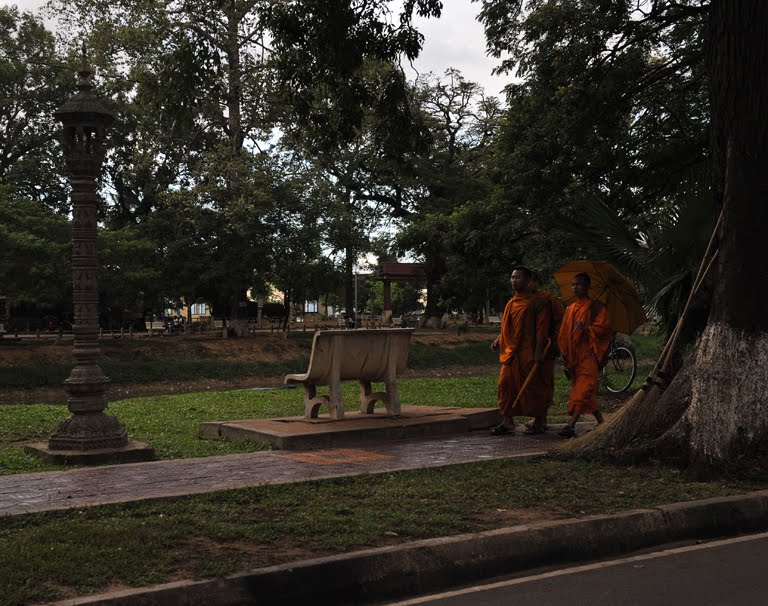
A walk in the park.
Imgae by Danielle Lancaster

A fabulous Cambodia friend - Chamnan